
What is EBITDA?
August 1, 2026
Have you ever applied for a business loan and been asked to provide your company's EBITDA? Or maybe you're considering selling your business and a potential buyer wants to know your EBITDA before making an offer? If so, you're not alone. EBITDA is one of the most common financial metrics requested by banks, lenders, investors, and potential business buyers because it helps them evaluate how profitable a business's operations are. While the name may sound intimidating, EBITDA is actually a straightforward calculation once you understand what it represents.
In this topic, we'll cover what EBITDA is, why it's important, who uses it, and how it's calculated.
EBITDA can provide a clearer picture of a company's operating performance than net income because it removes expenses that may vary based on financing decisions, tax situations, or accounting methods. The reasons it better reflects the operating profit are:
It removes the cost of financing, not the cost of running operations (interest),
It removes the cost of taxes, which is a legal obligation to the government based on the business’ net profits and not the cost of running operations, and
It removes depreciation and amortization expenses, which are accounting entries used to allocate the cost of an asset over time.
Although the asset is used in daily operations, depreciation and amortization are non-cash accounting expenses that allocate the cost of assets purchased in previous periods over their useful lives.
Keep in mind that EBITDA is only one financial metric. It does not consider loan payments, taxes, capital expenditures, or changes in working capital. While it is useful for comparing businesses and evaluating operating performance, it should be reviewed alongside cash flow and other financial reports when making business decisions.
Some lenders and buyers may also request Adjusted EBITDA, which starts with EBITDA and then removes unusual or one-time expenses that are not expected to occur again, such as lawsuit settlements, disaster-related costs, or owner-specific expenses.
How to Calculate EBITDA
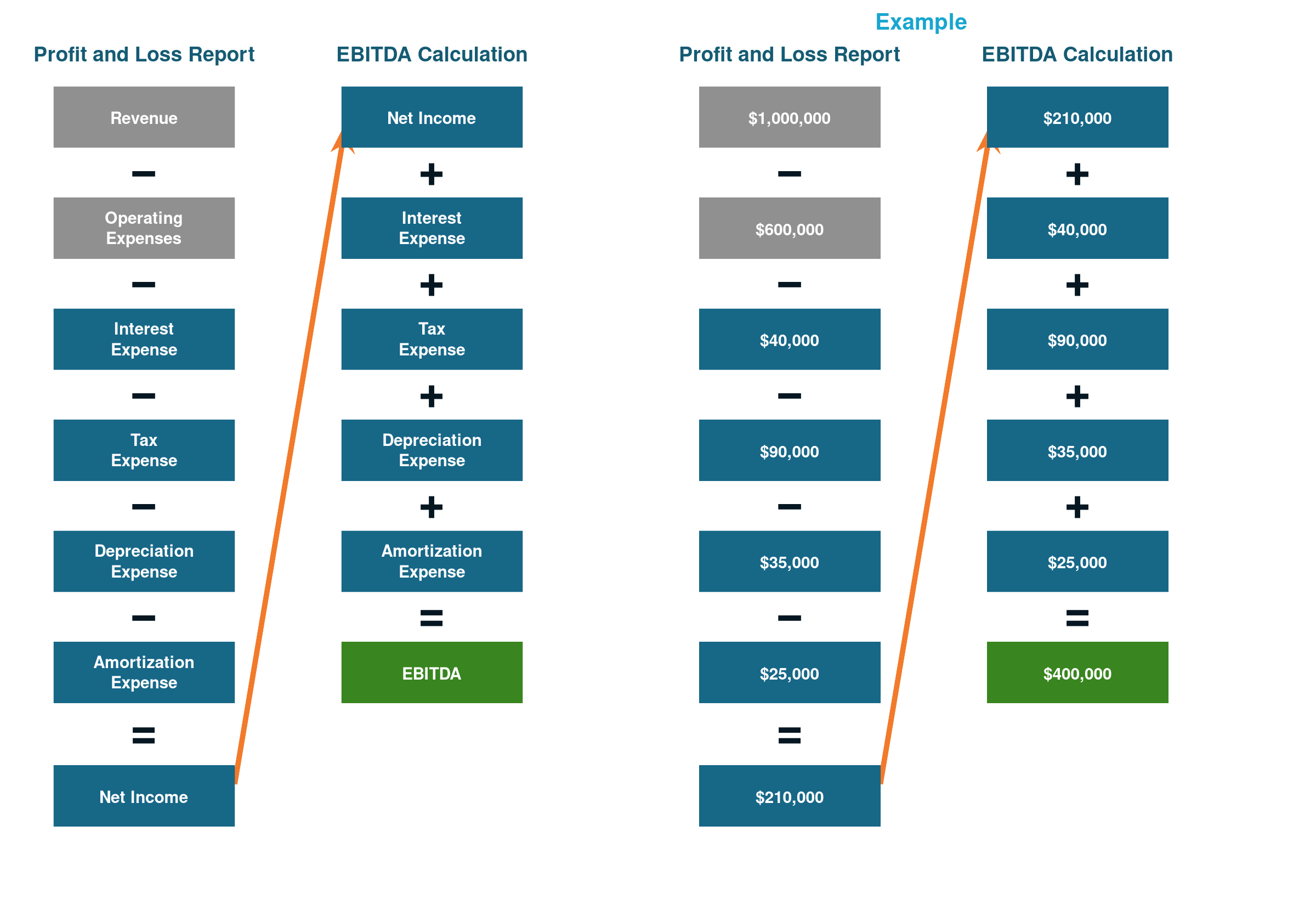
Here is the formula: EBITDA = Net Income + Interest + Tax + Depreciation + Amortization
We will dive into each item:
Net Income - This is the net income (revenue less expenses) of the business taken from the Profit and Loss report
Interest - This is the interest paid for any loans the business has (cost for debt)
Taxes - This is for the taxes from federal and state government obligations to be paid based on the business profits
Depreciation - This is an accounting entry based on spreading out the costs of fixed assets over time
Amortization - This is an accounting entry based on spreading out the costs of intangible assets over time
You will need your Profit and Loss report to gather the numbers to help you calculate the EBITDA. If you are struggling to find the right accounts that match the formula items above, then work with your accountant to help you gather these items.
Example:
John’s business is getting a loan from the bank, and they are asking for this year's EBITDA. This year, John’s business has revenue of $1,000,000, operating expenses of $600,000, interest expense of $40,000, tax expense of $90,000, depreciation expense of $35,000, and amortization of $25,000. EBITDA: $210,000 (net income) + $40,000 (interest) + $90,000 (tax) + $35,000 (depreciation) + $25,000 (amortization) = $400,000. See example chart below.
Common Mistakes to look out for
Forgetting to add back depreciation and amortization
Using principal loan payments instead of interest expense
Including owner distributions as an expense
Assuming EBITDA equals cash flow
Comparing EBITDA across unrelated industries
In Summary
EBITDA is one of the most widely used financial metrics for evaluating a business's operating performance. While most business owners don't need to calculate EBITDA every month, understanding what it measures can help you have more informed conversations with lenders, investors, and potential buyers.
If you're applying for financing, planning to sell your business, or simply want to better understand how your company compares to others in your industry, EBITDA can be a valuable tool. Just remember that it should be used alongside other financial reports—such as your profit and loss statement, balance sheet, and cash flow statement—to provide a more complete picture of your business's financial health.
If you're unsure how to calculate EBITDA or interpret what it means for your business, your accountant can help you prepare accurate financial information and explain how lenders or buyers may use it during their evaluation.
